Monday, April 11, 2016

1st grade @ ISU monarch lab

1st graders visit insect lab at ISU 
Five first grade students from Guthrie Center elementary school visited the ISU entomology department's monarch lab.  Keith Bidne, the insectary manager in the Entomology Department, had the students' attention as he showed them some monarchs which had just emerged from their chrysalis.  If you look closely, you can see that the monarchs emerged from a chrysalis that had formed on a 6 oz. cup!  The monarchs will be processed and moved to a larger home once their wings have dried.


(photo courtesy of Kris Langgaard)

Below Mr. Bidne sterilizes his equipment so he can test each recently emerged adult monarch for the disease OE.


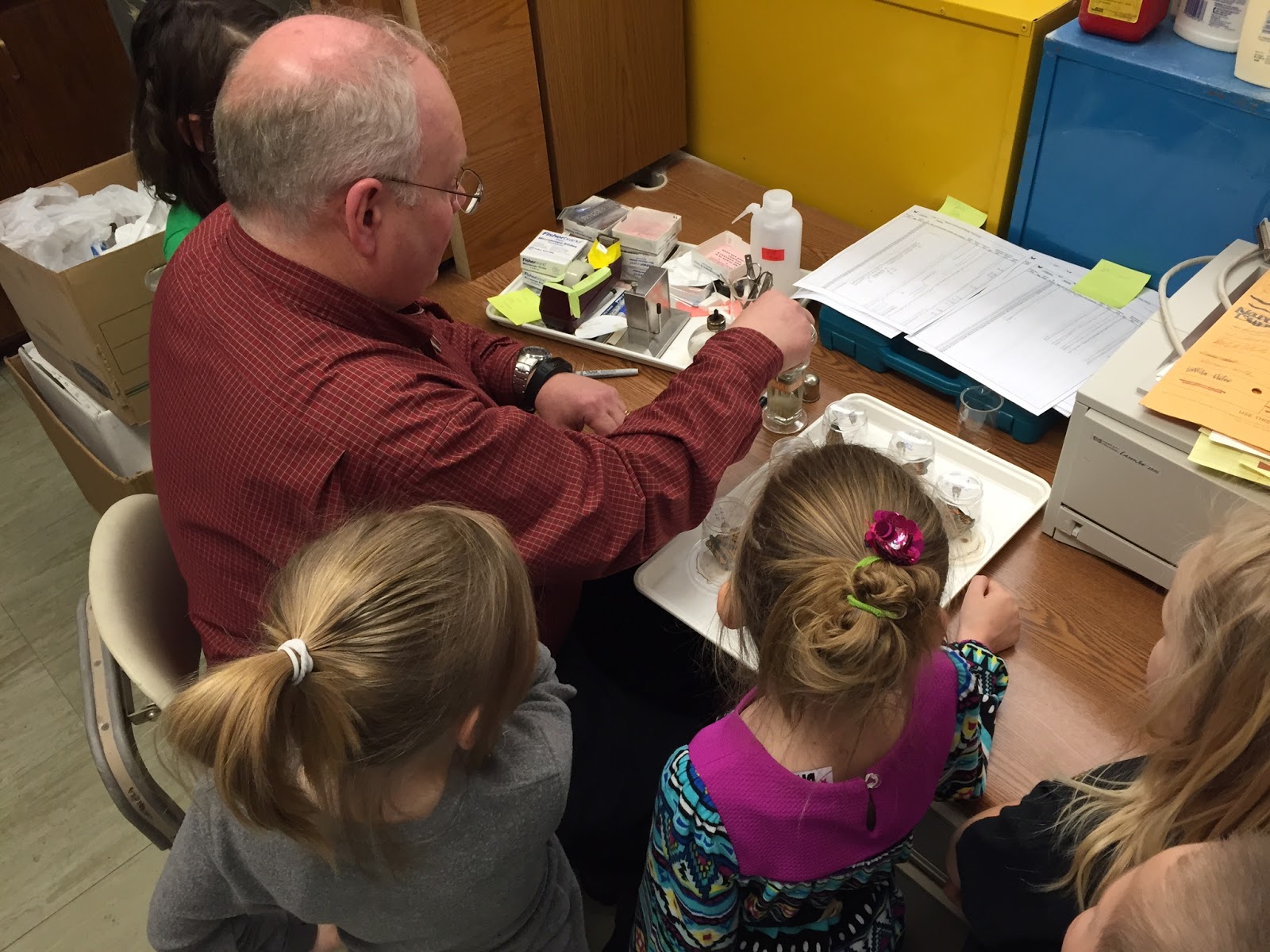
 Below: After sterilizing his equipment, Mr. Bidne takes a piece of tape and presses it against the monarch's abdomen.  He will look at each piece of tape under the microscope to see if any of the football shaped OE parasites are present.


The 1st graders also helped Mr. Bidne transplant some tropical milkweed in the greenhouse.  He even gave us some to take home!
(photo courtesy of Kris Langgaard)

1st graders to raise monarchs in May
At the beginning of May, Mr. Bidne will supply each of these 1st grade students with a monarch larva to care for.  Every day they will be responsible for cleaning the frass from their "cage," putting a new milkweed leaf in the cup, and writing about their observations.   When the butterflies emerge from their chrysalis at the end of the school year, we will release our monarchs in our school's rain garden, where our Conservation Corps  (our elementary students involved in after school conservation work) have planted the monarch's favorite milkweed and flowering plants.

1st graders in leadership role next fall
Next fall, as second grade students at Guthrie Center Elementary School, these students will be in leadership roles assisting other class members in raising their own monarchs.  This will be the second year in a row that our students will do that, thanks to the generosity of the ISU monarch lab.
 
A great website for elementary students to learn about monarchs:
https://www.learner.org/jnorth/monarch/
Before our field trip to ISU, 1st graders used this website to learn about monarchs.

To follow the ISU monarch consortium's activities and to learn about their latest research, go to: http://monarch.ent.iastate.edu/


Monday, March 14, 2016

Breaking news: Monarch numbers increase!

How are the number of monarchs counted every year?  One way is to count the number of acres (or hectares)  of oyamel forest land that are occupied by wintering monarchs in Mexico.  This helps determine whether monarch numbers are increasing or decreasing.  Two years ago monarchs wintering in Mexico had decreased by 95% and reached an alarmingly low amount.  Entomologists were concerned that monarchs might not be able to recover.   Thankfully, the past two years have had mild weather in Mexico, and monarchs wintering in Mexico have increased.

Just last week, Monarch Watch, the support organization of the University of Kansas, released their count showing an increased number of monarchs this winter in Mexico.  Monarch numbers more than tripled since last winter season.

As you can see from their graph below, in the 2014-2015 winter season, there were 1.13 hectares, or 2.8 acres (2 1/2 acre = 1 hectare) of land covered by monarch butterflies, compared to 4.01 hectares (9.9 acres) this winter season, more than 3 times more butterflies.  Looking closely at the graph, you can also see the high year is in 1996-97, where there were 18.19 hectares (45 acres) of land covered with wintering monarchs.  The low year was 2013-14, when monarchs only covered .67 hectares (1.7 acres) of land. 
http://monarchwatch.org/blog/uploads/2016/02/monarch-population-figure-monarchwatch-2016.png

There are a number of factors that contribute to a decreased amount of monarchs, many of which relate to loss of habitat in both the summer (Midwest cornbelt) and winter (Mexico) habitats.  Of course, deforestation of oyamel forests contribute to monarch's lack of protection during their November - March hibernation.  Late winter storms can also have a detrimental effect on monarch numbers.

However, one of the biggest reasons for loss of habitat is that since the late 1990's, farmers have been planting glyphosate tolerant corn and beans.  Therefore, when chemicals are sprayed to control weeds in fields, milkweed, the only plant that monarch larva can eat, are also killed, thereby reducing the number of monarch butterflies.  Recent efforts to increase milkweed numbers in gardens and non-crop areas, have no doubt helped adult monarchs find places to lay their eggs!  Efforts have been made by universities and garden centers to make milkweed more available to those of us who want to help monarch butterflies. 

Next 2 blogs:  ISU Monarch Consortium hosts 1st grade students;  Monarch migration beginning

Monday, February 22, 2016

Tall Green & Purple Milkweed

I'd like to share information about the tall green (Asclepias hirtella) and purple milkweed (Asclepias purpurascens)

Below is my research plot on August 7th with the 9 varieties of milkweed.  The tall green milkweed is in front of the grass, but you can't see a lot of green!  That's because not many of this variety of milkweed survived in my plot.  It also did not do well in Iowa State's research plots, so I'm assuming that it doesn't transfer well.   I did see one egg on a plant that was about 3 inches tall, but by the next week the plant had died.  I did replant some tall green last fall, so am hoping I have some come up this spring.


The tall green milkweed has a small greenish-white flower, long, skinny leaves, and grows to be 2-3 feet tall, so not so tall as the name suggests.  Basic information and photos are available at: http://www.illinoiswildflowers.info/prairie/plantx/tg_milkweed.htm

Prairie Moon Nursery's photos give you idea of what Ascelpias hirtella looks like:  https://www.prairiemoon.com/seeds/wildflowers-forbs/asclepias-hirtella-tall-green-milkweed.html

The purple milkweed has beautiful deep purple flowers, and grows to 4 feet tall.   I was introduced to this species at Neal Smith National Wildlife Center, and would love to have it in one of my flower beds.   It is not invasive, so would be a good selection for home gardens, if you can find it!   Go to the North American Butterfly Association's web site for a photo and information:
http://nababutterfly.com/purple-milkweed/

My next blog will be about the monarch's migration to Mexico.

Monday, January 18, 2016

Asclepias tuberosa (butterfly weed)


Butterfly weed is one of those flowers that people have in their garden and don't realize it's a milkweed.  With its orange flowers and smaller leaves and plant, it's not your typical milkweed.  Here's a close up of a butterfly weed in my front yard with a 3rd instar devouring one of its flowers.


Although all 6 of my butterfly weeds survived in my (wet) research plot, they didn't grow well.  I only had 5 eggs and one larva.  However, the plant in my front yard has been there for 5 years, and it has been very hardy.  In addition, it supports a large number of monarch larvae.  More than once this summer I counted a dozen larvae at one time.  As you can see from the photo below, mine is a large spreading plant, mostly because rabbits chowed down on it. (Which caused new shoots to grow up to replace them).  As you can see, the plant extends from the rock to the yardstick.


Usually eggs are laid on the underside of plants, but this one was laid on top of a butterfly weed.


 In just 2 weeks, the caterpillar below has grown from a larva the size of a dash to 2 inches long.  It has molted 5 times, and is now ready to find a place to hang and form a chrysalis.


Next week I'll be sharing information about the last milkweed in my research plot: Asclepias hirtella and a few other species that weren't in my research plot.

Monday, January 11, 2016

Poke Milkweed (Asclepias exaltata)

Poke milkweed is another species that doesn't look like a milkweed at first glance.  Its leaves are smooth, not as thick as common milkweed, and the shape of the leaf reminds me of a single ash leaf (although the shape can be oval to egg shaped).  Poke milkweed grows to 6 feet tall in woodlands, and if grown in too much sun, they lose some of their green color, as you can see on the lower leaves of the plant below.  They are native to eastern United States, with Iowa being on their western border.


My poke milkweed were fairly healthy with all 6 plants surviving.  I had a total of 8 monarchs:  5 eggs and 3 larvae throughout the summer.  You can see one of the eggs on the plant above.  Various websites report that they are not invasive, and in the wild the flowers attract flocks of butterflies (and rabbits).  The loosely packed flower clusters droop elegantly from slender stalks, somewhat like fireworks. 

For more information about growing conditions, seed germination, and photos, go to the Finger Lakes Native Plant Society's website:  http://flnps.org/native-plants/peaceful-gem-hiding-our-woods

Next week:  butterfly weed (Asclepias tuberosa)


Sunday, December 27, 2015

Honeyvine Milkweed (Cyanchum leave)

Honeyvine (swallow-wort) doesn't look like a milkweed with its heart-shaped leaves and creepIng vine.  (It belongs to a different genus than the other milkweed species). I wasn't sure why it was selected to be in the research plot, and, because it can be invasive, I certainly didn't cheer for it to do well.  However, all 6 plants survived, and it did sustain a number of monarch larvae.  In my research plot, there were 12 monarch throughout the summer on honeyvine; 7 eggs and 5 larva, ranking 6th out of the 9 milkweed species.  Here is what it looked like on August 15th in my research plot.

I found my first egg on honeyvine in on July 19th, and by the end of the July had two 5th instars.  In the middle of September when none of the other milkweed had monarch larva, I counted a 5th instar on honeyvine.


I don't know how invasive it will be, so certainly wouldn't recommend planting honeyvine at this point.  It has exceeded my expectations for attracting monarch, however, so we'll see what happens next summer!

Next week:  Asclepias exaltata:  poke milkweed 


Monday, December 14, 2015

Whorled Milkweed (Asclepias verticillata)

Whorled milkweed is an attractive, skinny-leaved species that only grows 2 feet tall.  It is beautiful in a flower garden!  However, I'm a little concerned it may be too invasive for many gardeners.  By the end of the summer I did have a number of new shoots growing around my original plants, and online, some people consider it aggressive.   As you can see below, it doesn't look much like a common milkweed.  Here is what it looked like in my research plot on August 15th.:

I also planted whorled in a couple of other flower beds, and despite the insignificant leaf, they did support monarch larvae.  In fact, in my research plot this summer, whorled milkweed ranked 4th out of the 9 milkweed species planted, with 25 monarch, 15 eggs and 10 larvae.  As you can see in this photo taken July 31st, it even supported a 5th instar monarch larva.

Whorled milkweed blooms a little later than most milkweed, (July to September) and the white flowers attract many insects.  They are supposed to be deer and rabbit resistant, but my rabbits loved it, or at least loved to chomp the tops off.  I planted a wave of whorled milkweed beside monarda, so I am anxious to see how invasive it will be in the next few years.  In the photo below, the whorled milkweed is on the left (with the yardstick in the middle of them), and there is a wave of bee balm directly above them to their right.  Lantana, butterfly weed and black-eyed susan are above the monarda.


Wednesday, December 2, 2015

Prairie Milkweed (Asclepias sullivanti)

Prairie milkweed looks similar to common milkweed, but is less aggressive, and has smaller fragrant flowers.  It grows to about 3 feet tall, attracts hummingbirds, bees and butterflies, and has smooth, thick leaves.  In my research plot this summer, I had 24 total monarch (15 eggs and 9 larvae) on my prairie milkweed, just behind whorled, which had 25.
After only having milkweed in my garden for one year, the prairie species would be one of my recommendations for flower gardens.  However, It will be interesting to see how aggressive and hardy it is for me in the next few years.
Here is a monarch egg (about the size of a pinhead) on a prairie milkweed on July 19th, a month after planting.  A great majority of eggs are laid on the underside of leaves, like the one below.  Eggs hatch in 3-5 days.


On July 27th, a first instar larva is enjoying its meal of milkweed.  Monarchs go through 5 instars, molting between each, when its skin becomes too tight.  It will spend 2-3 days in each instar, for a total of 10-14 days as larva.


In my regular garden I had to make fences out of hard wire mesh to protect the milkweed that weren't inside my rabbit proof fence.  As you can see in the photo below, two larvae have moved off the plant to molt, a common occurrence.  Larvae will frequently take a day or two off from eating when they are molting.


Saturday, November 28, 2015

Showy Milkweed (Asclepias speciosa)

I planted my milkweed research plot on June 21st.  Just one week later, on June 29th, I had 3 monarch eggs on my showy milkweed plants (and no eggs on any other milkweed species).  By July 2nd, a caterpillar had emerged.   It was so exciting to have those first monarchs to watch!  Look on the photo below for the larva's little black head on this showy milkweed.  The caterpillar has just emerged, and before starting its milkweed diet, it will turn around and eat its egg shell, which is directly in front of it.


Showy milkweed is closely related to common, has vigorous growth, but is not as invasive.  It, too, can grow to 5 feet tall, and also has long, thick hairy leaves.  My showy milkweed seemed to grow more horizontally than my common.  Below is a photo of a 2nd and a 5th instar caterpillar on showy milkweed.

Here are the 6 showy milkweed in my research plot on July 30th.


Thursday, November 26, 2015

Common milkweed (Asclepias syriaca)

Common milkweed , the bane of farmers and bean walkers!  However, it is a staple in a monarch's diet, and in my research plot this summer, had the second highest count of monarchs, with 30 total: 19 eggs and 11 larva.  In the prairie, you can see how tall this milkweed will grow, if you notice there is another common milkweed over my left shoulder in this photo taken at Neal Smith National Wildlife Refuge.


This perenniel grows from deep rhizomes, so once it's established, I'll need to control its spread in my flower bed.  Here is a fifth instar preparing to form a chrysalis on August 15th.  Notice that the common milkweed's elliptic leaves are fuzzy, particularly on the underside.  

On August 16th, the caterpillar had formed a chrysalis.

When I approached the plant on August 30th, a monarch butterfly flew off the plant.  Usually adults emerge in the morning and it takes most of the day to inflate and dry its wings so it can fly. Notice the reddish fluid (called meconium) on the leaf below:  that is leftover metabolic waste that was expelled after the butterfly emerged.


Friday, November 20, 2015

Swamp Milkweed (Asclepias incarnata)

With our wet year, swamp milkweed flourished, which could be one reason why this species had the most monarch eggs and larva in my plot. They were also the only variety that bloomed the first year for me.  Here is swamp milkweed in my research plot with a 3rd instar monarch larva under one of the leaves.


Research was completed this summer by members of the Monarch Consortium to determine which type of milkweed attracted the most monarchs.  (Hopefully I'll be able to report about their findings in future blog posts.)  Every week, those of us with milkweed plots counted the number of eggs and larva on each of the 54 milkweed we planted.  We also took note of things like the condition of the milkweed, presence of spiders and aphids, and the amount of rain.  Of the 9 milkweed species in my plot, swamp milkweed was the species that had the most eggs and larva, with a total of 40 eggs and 17 larva counted throughout the summer.   Swamp milkweed are a tall, slender-leaved plant.  If you look closely at these swamp milkweed, you can see a 4th instar caterpillar on the end of a leaf, level with the 33" mark on the yardstick.

Monday, November 16, 2015

Milkweed


This is my milkweed plot at the end of the year, on October 10th.  After one summer in the ground, I thought it might be helpful to share my observations about each variety, even though I'm sure I'll be more milkweed savvy in a couple more years.
The  milkweed are around the outside of this garden with flowers and grasses on the inside.  Contrary to what I read online, rabbits do enjoy eating milkweed, so I had to put them inside a rabbit-proof fence.  Directly in the front (with the fence posts to support them) are the honeyvine milkweed (Cynanchum leave).  Going counterclockwise around the garden are: showy milkweed (Asclepius speciosa), whorled milkweed (Acslepias verticillata), prairie milkweed (Asclepias sullivanti), poke milkweed (Asclepias exaltata), common milkweed (Asclepias syriaca), swamp milkweed (Asclepias incarnata), tall green milkweed (Asclepias hirtella), and butterfly weed (Asclepias tuberosa).  
Part of the research I did with my plot, was to keep a weekly record of how many monarch eggs and larva each plant & variety had on it.  So, each week for the next 9 weeks I will be sharing my observations about a different variety of milkweed, beginning next week with the milkweed variety that totaled the most eggs and larva in my garden his year, Asclepias incarnata, or swamp milkweed.

Monday, November 2, 2015

Iowa Monarch Conservation Consortium

In an effort to enhance the monarch butterfly's habitat in rural and urban Iowa, a monarch consortium was created in 2015, led by Iowa State University.  Farmers, conservation organizations, state agencies, companies and ISU's College of Agriculture and Entomology belong to the consortium.  Iowa State is leading research to develop cost effective methods and coordinate resources, information and support. Go to the following website to learn more:
Monarch.ent.iastate.edu/
As part of the consortium, nine different varieties of milkweed were planted across the state to determine monarch preferences and establish cost-effective methods to maintain milkweed.  I planted my own research plot:

Monday, October 19, 2015

Monarch Watch garden

The University of Kansas is doing their part to help monarchs.  Besides the research that Chip Taylor and his staff do, they also offer a "Monarch Watch" certification for individuals, schools and other groups.  To become certified, you need to have planted a number of milkweed and nectar plants preferred by monarchs in your garden. (The garden can be fairly small.)
 Go to their website for more information: http://www.monarchwatch.org/waystations/
Our elementary school at Guthrie Center became "Monarch Watch" certified this summer, by taking an existing rain garden, planting a couple different kinds of milkweed and adding a few annuals and perennials.  Here is conservation team member, Allison, talking to a student in front of our garden this fall:

Monday, October 5, 2015

First blog post

I've started this blog to share my passion for monarchs.  They are dangerously close to being put on the endangered species list, so their amazing migration to Mexico is in jeopardy.   The number of monarchs overwintering has dropped 95 percent since 1995.  Along with many other people I am doing what I can to increase their numbers.  Here I am at Neal Smith National Wildlife Refuge: